
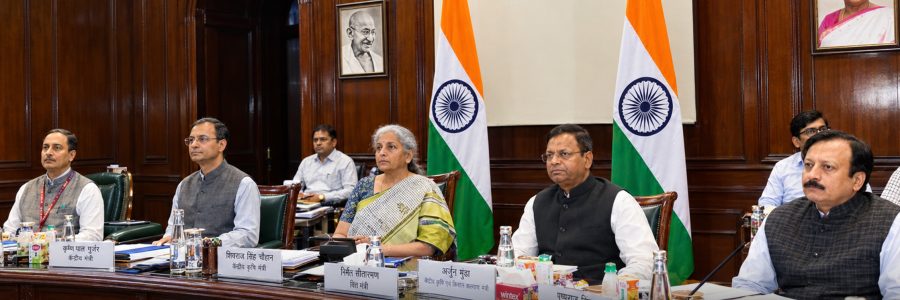
(Insights from the 57th GST Council Meeting, held 8 October 2026, New Delhi)
Note: These are Council recommendations. They take legal effect only through notifications, circulars and law amendments.
The Big Picture
In 2025, the 56th GST Council meeting gave India “Next-Gen” GST, a reform built around rate rationalisation. On 8 October 2026, the 57th Council turned to the harder and less glamorous question of process.
Rates decide how much you pay. Process decides how much time, money and anxiety it costs you to pay it. The 57th meeting was about the second part.
The headline is that the Council has recommended removing arrest powers under GST altogether by omitting Section 69 of the CGST Act. That is not the only story, though.
1. Trust Over Threat: The Enforcement Reset
| Provision | Current | Recommended |
| Arrest powers (Sec. 69) | Available | Withdrawn entirely |
| Prosecution threshold | ₹1 crore | ₹5 crore |
| General penalty (Sec. 125) | Up to ₹25,000 | Up to ₹10,000 |
| Show-cause notices | No minimum | None below ₹10,000 of tax |
| Minimum penalty (non-fraud) | ₹10,000 | Removed |
Our view: The Council describes this as a “trust-based” regime that still keeps effective deterrence. The prosecution provisions are being narrowed, not abandoned. Fraudulent ITC availment without actual goods, services or invoices stays squarely in the crosshairs. What changes is the tone: from presumption of guilt to presumption of good faith.
The dispute-resolution package reinforces this:
- A reduced 5% penalty in non-fraud cases if tax and interest are paid within 30 days (Sec. 73) or 60 days (Sec. 74A) of the adjudication order.
- A cap of ₹40 crore on pre-deposit for appeals where only a penalty is involved.
- Guidelines on the quality and timeliness of notices, and on invoking fraud or suppression only on the merits of each case.
2. Your Working Capital Just Got a Friend
For CFOs and treasury heads, the refund reforms may be the most important part of this release.
Phase 1 (automation begins)
- Excess cash ledger balance is refunded automatically, with no officer involved.
- Acknowledgement or deficiency memo timelines drop from 15 to 10 days, with deemed acknowledgement if the officer stays silent.
- For zero-rated supplies and inverted duty structures, 90% of the claim is sanctioned provisionally by the system, based on risk evaluation.
Phase 2 (full automation)
- System-driven acknowledgement and sanction of the full refund for zero-rated supplies.
Also notable
- Accumulated ITC on capital goods (zero-rated supplies) and on input services and capital goods (inverted duty) becomes refundable. Input services refunds apply to ITC availed from 1 November 2026. Capital goods refunds are spread over 60 months for ITC availed from 1 April 2027.
- The cap restricting zero-rated goods turnover to 1.5 times comparable domestic supplies is removed.
Our view: Capital-intensive and export-oriented businesses in particular should revisit their cash-flow forecasts and tax-credit positions now, not at the notification stage.
3. Fewer Mismatches, Fewer Notices
Anyone who has received a system-generated GSTR-3B mismatch notice will welcome this section. The Council recommends a new architecture, planned from the April 2027 return, that includes:
- Two new portal statements: an Electronic Credit Reversal and Reclaim Statement and an Electronic Statement of RCM tax and ITC.
- Statutory mechanisms to correct liability and ITC in returns so they align with GSTR-1/1A/IFF and GSTR-2B.
- Formal recognition of the Invoice Management System (IMS), letting recipients accept, reject or keep documents pending, with limits on how long a credit note can stay pending.
The Council also proposes placing this mechanism in the public domain for time-bound stakeholder consultation, which is an opportunity to shape the final design.
4. Registration: Born Automatic, Cancelled Automatic
- Registration: clearer guidelines, drop-down document selection in FORM GST REG-01 and a friendlier portal interface.
- Amendments: most registration particulars (except Principal Place of Business for regular filers) will be accepted automatically.
- Cancellation: a two-phase move towards automatic acceptance of cancellation applications once returns are filed and dues paid. Tax officers’ discretionary cancellation grounds are being trimmed.
- E-commerce sellers: a new Rule 14B lets small sellers selling through e-commerce platforms register in other states by declaring the platform’s warehouse as their Principal Place of Business, where ITC pass-through is within ₹2.5 lakh a month.
Our view: Rule 14B could change how small sellers expand. A seller in Kerala could reach customers in Maharashtra without leasing space there.
5. Movement of Goods: Fewer Roadblocks, Literally
The e-way bill and interception provisions are being tightened:
- Interception only on specific intelligence, authorised by an officer not below Joint Commissioner.
- No interception in transit states. Action is possible only where the supplier or recipient is located or registered.
- Confiscation under Section 130 will not apply to goods in transit.
- Goods travelling with no e-way bill or origin/destination documents can still be inspected, detained or seized, irrespective of jurisdiction.
For logistics operators and manufacturers, this promises fewer unplanned halts on the highway.
6. ITC: Unblocking the Blocked Credits
The Council recommends easing Section 17(5) restrictions on credits for items including outdoor catering, health and life insurance, telecommunication towers, pipelines laid outside factory premises, free samples, and goods destroyed or written off on expiry of shelf life as required by law.
In services, limited ITC in the same line of business is proposed for restaurants and outdoor catering, hotel accommodation (up to ₹7,500 per unit per day) and gym and fitness services.
7. Exporters and Service Providers
- Services supplied to or through foreign branches or offices of the same entity could qualify as export of services.
- Place-of-supply changes for services performed on goods supplied by the recipient could open up export benefits.
- Supplies of goods to overseas buyers delivered in an SEZ/FTWZ will get greater certainty on zero-rating.
- Transfer of title in IPR, temporary or permanent, will be uniformly treated as a supply of services.
8. Sector Spotlights
- Mobility and EVs: an option to pay GST at 5% (restricted ITC) on passenger transport and motor vehicle rental services using electric vehicles, where battery charging cost is included.
- Gig and e-commerce delivery: delivery services through e-commerce platforms (other than courier and postal) attract 5% without ITC, with the platform liable under Section 9(5).
- Waste and recycling: plastic waste, e-waste, tyre scrap and used cooking oil move under Reverse Charge, with 2% TDS on registered-to-registered supplies.
- Agriculture: GST exemptions for seed storage and warehousing, and for coffee curing. Nil rate for psyllium seeds (isabgol).
- Infrastructure: exemption for upfront concession amounts paid to NHAI under the Toll-Operate-Transfer model, with a special valuation and payment procedure for O&M services.
- Banking: clarity that notional “interest” in Funds Transfer Pricing between branches falls within the definition of interest.
- Remote connectivity: GST exemption on seat-sharing helicopter services to and from the North-East, Sikkim and Bagdogra.
9. For Small Businesses
- Late fee waiver for taxpayers with turnover up to ₹5 crore, if the delayed GSTR return is filed by the end of the month in which it was due.
- An in-principle optional Annual Return Quarterly Payment (ARQP) scheme for B2C-only businesses with turnover up to ₹5 crore.
- The ability to object to blocking of electronic credit ledger under Rule 86A, with a personal hearing.
Not All Relief: The Compliance Tightening
- E-invoicing extends to RCM supplies from unregistered persons and import of services for businesses with turnover of ₹5 crore and above.
- Waste and scrap taxation shifts to RCM and TDS mechanisms.
- The new return-correction architecture will require better ERP-to-GST reconciliation from April 2027.
What Should You Do Now?
- Map the impact. Identify which reforms touch your business: refunds, blocked credits, exports, RCM or e-commerce.
- Model the cash flow. Quantify the refund and ITC unlocking, especially for capital goods and services.
- Audit your ERP. Ready your systems for the April 2027 return-correction regime and expanded e-invoicing.
- Review open disputes. The new thresholds and reduced penalty windows may change your settlement calculus.
- Participate in consultations. The Council has invited feedback on the revised return mechanism.
- Wait for the notifications. Recommendations are not law until formally notified.
The Markwart Perspective
GST began as a story about unifying markets. Then it became a story about rationalising rates. The 57th Council meeting suggests the next phase is about building trust between taxpayer and administration, using automation and clearer rules.
The details will matter. The notifications, circulars and FAQs will decide whether the promise is delivered in full. For businesses, this is a good moment to look beyond compliance and treat tax as a lever for working capital, expansion and risk management.
Wondering how these changes affect your business? Speak to the tax advisory team at Markwart Consultants for a tailored impact assessment.
Source: Press Information Bureau, Ministry of Finance, “Recommendations of the 57th Meeting of the GST Council,” 8 October 2026. This article is for general information only and does not constitute legal or tax advice. Recommendations of the GST Council become effective only through the relevant notifications, circulars and amendments.